
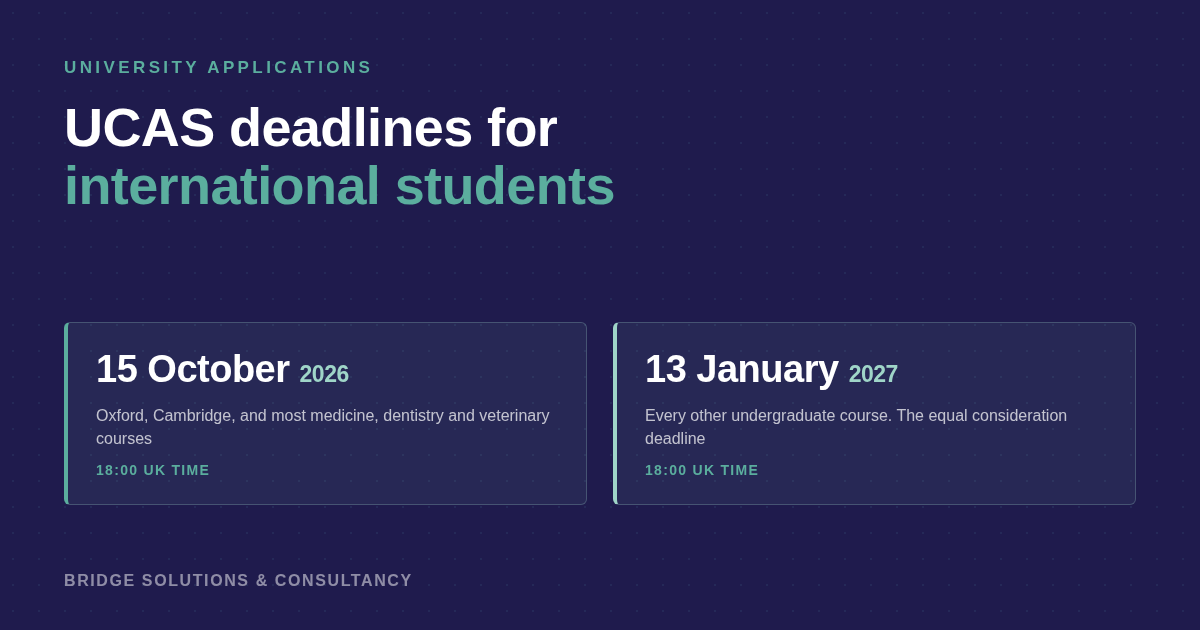
UCAS deadlines for international students are the same as for UK applicants. For 2027 entry, that means 18:00 UK time on 15 October 2026 for Oxford, Cambridge and most medicine, dentistry and veterinary courses, and 18:00 UK time on 13 January 2027 for everything else.
The dates are the easy part. What catches international applicants out is everything that must be finished before the application can be submitted at all: a reference from a school in a different time zone, an English language test with limited sitting dates, predicted grades in a qualification the UK system needs to interpret. This guide covers the deadlines and the work that sits behind them.
International students do not always apply through UCAS. They can make direct applications to universities too. Most apply through an agent, to avoid making mistakes on the application.
Rasheda Zaher, founder, Bridge Solutions & Consultancy
- The dates for 2027 entry
- What “equal consideration” actually means
- The reference is usually the bottleneck
- English language evidence
- The visa runs on a separate clock
- Common questions
The UCAS deadlines for 2027 entry
15 October 2026, 18:00 UK time. Oxford and Cambridge, and most courses in medicine, dentistry and veterinary medicine or science. This one is absolute. There is no late route into an Oxbridge cycle.
13 January 2027, 18:00 UK time. Every other undergraduate course. This is the equal consideration deadline.
30 June 2027. The last date UCAS will forward an application to universities at all. After this, applicants go into Clearing.
Note the times. 18:00 UK time is not midnight, and it is not 18:00 where the student happens to be sitting. A family in the Gulf submitting at what feels like early evening has already missed it.
What “equal consideration” actually means
Applications received by 13 January must be considered equally by universities. Nobody gets an advantage for applying in September rather than January.
What it does not mean is that late applications are refused. UCAS keeps forwarding them until 30 June, and universities may still consider them, but only where places remain. On a competitive course there will be none. On a less competitive one there may be several.
The practical reading: treat 13 January as the real deadline, and do not comfort yourself that June exists.
Not sure your application is on track? We advise students and families on UK university applications, and our founder, Rasheda Zaher, has spent over twenty years in UK and international education. Book a call and we will tell you where the gaps are.
The reference is usually the bottleneck
A UCAS application cannot be sent without a reference, and the reference is written by someone else. That is the part applicants do not control.
If the student is at a school outside the UK, the referee may never have written a UCAS reference before. The format has changed: it is now three structured sections rather than free prose, which is easier once someone has seen it and confusing the first time. Send the referee the UCAS guidance early, in writing, and ask for a date they will have it done by.
Predicted grades matter as much as the prose. A referee predicting against an unfamiliar UK tariff, or playing safe because that is the local habit, can undercut a strong candidate without meaning to. Have the conversation about what the grades will actually say before anything is submitted.
Leave four weeks for this. Not one.
English language evidence
Most universities set an English language condition, usually IELTS or an equivalent, and most will accept the test result after the UCAS deadline as a condition of the offer rather than before it. That is a relief, but it creates its own trap: a student who leaves the test until the summer can hold an offer they then cannot meet.
Test dates are finite and centres fill. Book early, and book with enough runway to resit once if the score comes in below the condition. A resit in August, with a visa still to apply for, is not a comfortable position.
Check the requirement per course, not per university. Departments differ, and a course that asks for a higher score in writing than in the other components is common.
The visa runs on a separate clock
You cannot apply for the Student visa until the university issues a Confirmation of Acceptance for Studies, and that only happens once the offer is unconditional. So the sequence is fixed: offer, then conditions met, then CAS, then visa.
For a student whose offer is conditional on summer results, that whole chain compresses into a few weeks in August. Nothing can be brought forward. What you can do is have everything else ready: passport valid well beyond the course end, financial evidence held for the required period, and the tuberculosis test done if the country of residence requires one.
A workable order of events
- Shortlist courses by entry requirement, not by university ranking
- Brief the referee in writing, with a date
- Book the English test, leaving room for one resit
- Draft the personal statement, then leave it a fortnight and rewrite it
- Submit well before the deadline, not on it
- Meet conditions, request the CAS, apply for the visa
Common questions
What is the UCAS deadline for international students?
The same as for UK students. For 2027 entry that is 18:00 UK time on 15 October 2026 for Oxford, Cambridge and most medicine, dentistry and veterinary courses, and 18:00 UK time on 13 January 2027 for all other undergraduate courses.
Can you apply to UCAS after the January deadline?
Yes. UCAS forwards applications to universities until 30 June 2027, but they are only considered where places remain. On competitive courses there usually are none, so the January date should be treated as the real deadline.
How many universities can you apply to through UCAS?
Five choices on one application. You cannot apply to both Oxford and Cambridge in the same cycle, and medicine, dentistry and veterinary courses are limited to four choices, leaving the fifth for a different subject.
Do international students need IELTS for UCAS?
Not for UCAS itself. Individual universities set English language conditions, usually IELTS or an accepted equivalent, and normally as a condition of the offer rather than something needed at application. Requirements vary by course, not just by university.
When should international students apply for a Student visa?
Only after the offer becomes unconditional and the university issues a Confirmation of Acceptance for Studies. For students holding conditional offers on summer results, that means August, so have financial evidence and passport validity sorted well in advance.
Talk to us about a university application
We advise students and families on placement into UK universities, and we stay involved after the offer rather than stopping at it. If you would like someone to look over where your application stands, book a 30 minute call, or read about our student placement service and English language preparation.