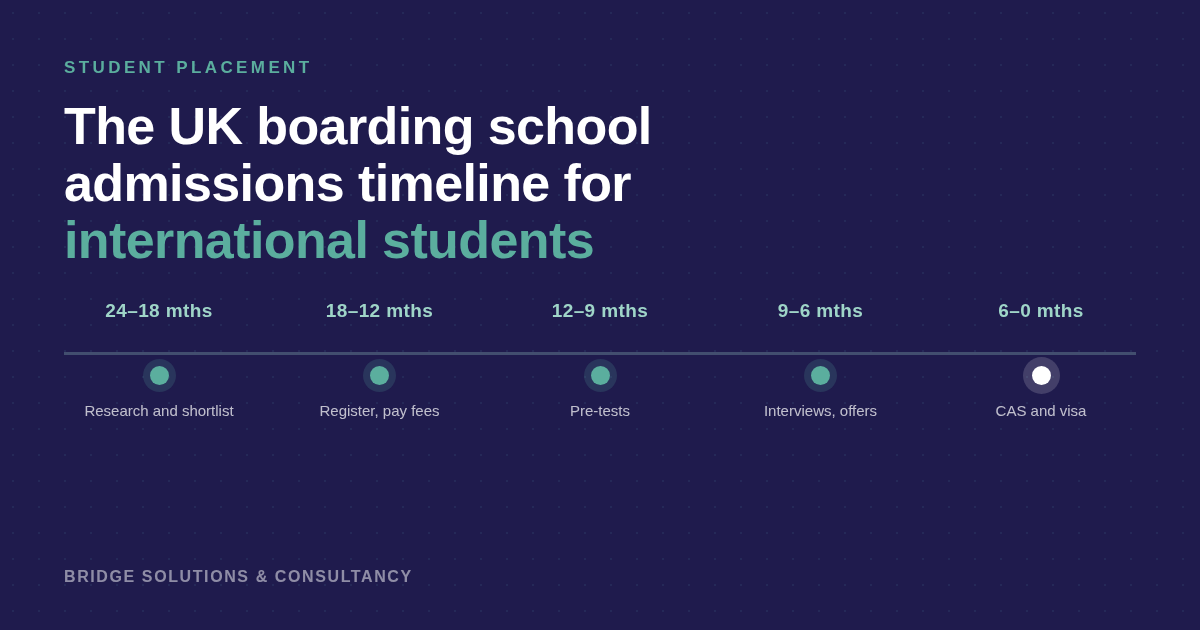
The UK boarding school admissions timeline for international students runs 12 to 24 months ahead of the September you want your child to start. Registration usually closes in the autumn of the preceding year, assessments follow between October and March, and the visa is the last step in the process, not the first.
Families who miss out on a place rarely miss it on merit. They miss it on timing. By the point many parents begin looking in earnest, registration at their preferred schools has often closed, and what remains is whatever still has space rather than what actually fits the child. This guide works backwards from a September start, setting out what happens at each stage and where the deadlines really bite.
- Know your entry point first
- The timeline, working backwards
- Assessments and pre-tests
- What schools ask you for
- The Child Student visa comes last
- Common questions
Know your entry point first
UK schools do not take pupils on a rolling basis. Admission happens at fixed entry points, and every date in the process hangs off which one applies to your child.
The standard points are 11+ (Year 7), 13+ (Year 9) and 16+ (Year 12, the start of A levels). A smaller group of schools also admits at 7+ and 9+. Places in other year groups do come up when a family relocates or a pupil leaves, but they are not something you can build a plan around.
The distinction matters because lead times vary considerably. A 13+ place is frequently settled by a pre-test sat 18 months or more before the child would join. At 16+ things move faster, with assessment usually six to nine months ahead. Parents who assume the same calendar applies at every age are the ones who find they have arrived too late.
The UK boarding school admissions timeline, working backwards
Take the September you are aiming for and count backwards.
24 to 18 months before: research and shortlist
Put together a shortlist of six to ten schools. Examine academic results, but look harder at what results cannot tell you: how many boarders remain at weekends, what pastoral support looks like day to day, and how many international students are already there and from which countries. A school with three pupils from your country is a different place from one with thirty.
18 to 12 months before: register
Registration means a form and a fee, normally non-refundable and typically in the low hundreds of pounds per school. It is not an application, and it commits you to nothing. What it does is put your child on the list to be assessed. Miss the registration deadline and, in most cases, you are out for that year, however strong the child may be.
Register at several schools. For families applying from overseas, three to five is typical.
12 to 9 months before: assessment
This is when pre-tests and entrance assessments take place, together with English language testing where a school asks for it. For 13+ entry the pre-test frequently sits earlier still, sometimes in Year 6 or Year 7.
9 to 6 months before: interviews and offers
For overseas families, interviews are often held online, and schools are upfront about that. Offers for a September start generally arrive between January and March. You will usually have a few weeks to accept and pay a deposit.
6 months to start: acceptance, CAS and visa
After you accept, the school issues a Confirmation of Acceptance for Studies, the CAS. The visa application is built on that document, and nothing can be submitted until it exists.
Not sure which entry point applies to your child? We place students into UK schools, colleges and universities, and we begin by weighing the options against location, budget and what the student genuinely wants to study. Book a call and we will give you an honest view of whether your timeline is realistic.
Assessments and pre-tests
Selective schools generally use either the ISEB Common Pre-Test or their own in-house papers. The ISEB test is sat once and the result shared with several schools, so a child is not repeating the same exercise. It is computer-based and adaptive, covering English, maths, verbal and non-verbal reasoning.
A word of caution on non-verbal reasoning. This is the section where international candidates most often fall short, rarely through lack of ability. The question formats are simply unfamiliar, and a child meeting that style of question for the first time is being tested on the format as much as on the reasoning itself. A few weeks of familiarisation is normally enough to close the gap.
If English is not your child’s first language, expect a separate English assessment. Some schools accept an external qualification in place of their own test, and it is worth asking that question early, since the answer changes what your child needs to prepare.
What schools ask you for
The paperwork is broadly consistent from school to school: reports covering the last two years, usually with a certified English translation; a reference from the current head teacher, which the school will often request directly rather than through you; evidence of English proficiency; passport copies; and occasionally a personal statement from the child.
Translations are the single most common cause of delay. If reports are not in English, have them translated before you register rather than waiting for a school to ask. Three schools asking in the same fortnight is a predictable scramble, and an avoidable one.
Schools will also ask about any additional learning needs. Disclose them. A school equipped to support a need will tell you so, and a school that finds out after the fact is a far worse outcome for the child than an honest decline at the outset.
The Child Student visa comes last
The Child Student visa covers pupils aged 4 to 17 attending an independent school in the UK. You cannot apply until the school has issued a CAS, the earliest you can apply is six months before the course starts, and you then have six months from receiving the CAS to make the application.
The funds requirement works differently for boarders. Where the child will live on site and board and lodging are covered in the school fees, there is no need to show separate living cost funds. You do, however, need to show you can pay the course and boarding fees for one academic year as stated on the CAS. The eligibility guidance sets out the current position.
Allow more time than the minimum. Processing times differ by country and by season, and a visa submitted in the same month as the flights makes for a very uncomfortable August.
What to do if you are already late
Starting late is not the end of it, but it changes how you have to approach things. Occasional places do appear, and a school with space is not automatically a weaker school; it is often simply one that is less well known overseas. What you lose is choice, and with it, room to negotiate.
When a family comes to us late, we look for an alternative. These are independent schools, so if there is a place, a late applicant can usually be accommodated.
Rasheda Zaher, founder, Bridge Solutions & Consultancy
If you are already inside 12 months for a 13+ place, be realistic about which schools remain open, and weigh up whether a January start or a different entry point would serve the child better than forcing a September place that does not fit. We would rather tell a family to wait a year than put a child somewhere they will be unhappy.
Common questions
How far in advance should you apply to a UK boarding school?
Begin 18 to 24 months ahead of the September you want your child to start. Registration deadlines usually fall in the autumn of the preceding year, and at 13+ the pre-test can sit 18 months or more ahead of the start date.
What entry points do UK boarding schools have?
The main ones are 11+ into Year 7, 13+ into Year 9 and 16+ into Year 12. Some schools also admit at 7+ and 9+. Places in other years do arise, but they cannot be planned for.
Do international students need to sit an entrance exam?
At selective schools, yes. Most rely on the ISEB Common Pre-Test or their own papers, and English language testing is standard where English is not the first language. A small number of schools assess on reports and interview alone.
When can you apply for a Child Student visa?
No earlier than six months before the course starts, and only once the school has issued a Confirmation of Acceptance for Studies. You then have six months from the date of the CAS to apply.
What documents do UK boarding schools ask for?
Typically two years of school reports with certified translations, a reference from the current head teacher, proof of English proficiency, passport copies, and sometimes a personal statement. Arrange translations before you register rather than when a school requests them.
Talk to us about a placement
Our founder, Rasheda Zaher, has been placing students into UK education for over twenty years, and we stay involved after the offer letter rather than stopping at it. If you would like to talk through where your child sits on this timeline, tell us the entry point you are aiming at and we will be straight with you about what is realistic. Book a call, or read more about our student placement service.